
Efficacy
ASCEMBL STUDY DESIGN
ASCEMBL: The first 3rd-line+ Phase 3 trial in CML evaluating efficacy and safety vs a 2nd-generation TKI comparator1,2
Multicenter, randomized, active-controlled, and open-label study1,2

Primary end point3
MMR at Week 24
Key secondary end point3
MMR at Week 96
Other select secondary end points2
Cytogenetic response rates and MMR rates, at and by scheduled data collection time points
Time to and duration of MMR
Time to and duration of CCyR
Safety and tolerability
Key baseline characteristics2
Resistance to last prior TKI: 61% of patients in the SCEMBLIX arm vs 71% with bosutinib
Intolerance to last prior TKI: 38% of patients in the SCEMBLIX arm vs 29% with bosutinib
MCyR at baseline: 29% of patients in the SCEMBLIX arm vs 29% with bosutinib
Percentages of patients who had previously received 2, 3, 4, or 5 or more prior lines of TKIs were 48%, 31%, 15%, and 6%, respectively
EFFICACY IN PATIENTS IN LATER LINES
SCEMBLIX is the first treatment to demonstrate superior response rates vs bosutinib in a Phase 3 trial1,4-11
FOR ADULTS WITH Ph+ CML-CP, PREVIOUSLY TREATED WITH 2 TKIs1
SCEMBLIX more than doubled the MMR rate at Week 96 vs bosutinib1

Median follow-up was 28 months1
The median duration of treatment was 24 months (range: 0 to 46 months) for patients receiving SCEMBLIX and 7 months (range: 0 to 43 months) for patients receiving bosutinib.1

SCEMBLIX demonstrated durable response rates across nearly 2 years of data12

Percentages of patients who had previously received 2, 3, 4, or 5 or more prior lines of TKIs were 48%, 31%, 15%, and 6%, respectively.1
Almost all SCEMBLIX patients who achieved MMR maintained it for more than 16 months (97% probability).12
SCEMBLIX demonstrated fast responses at Week 24 and increased depth of response at Week 961,3
More patients achieved CCyR at Week 24 with SCEMBLIX vs bosutinib1

The CCyR rate at Week 96 was 40% (95% CI, 30-50) in patients receiving SCEMBLIX and 16% (95% CI, 8-28) for bosutinib. Note that any patients who achieved CCyR and later achieved MMR would not have been assessed for CCyR at Week 96. Of patients achieving CCyR during the study, 1 patient in the SCEMBLIX arm and 2 patients in the bosutinib arm lost response1,3
More patients achieved MR4 and MR4.5 at Week 96 with SCEMBLIX vs bosutinib3

EFFICACY IN PATIENTS WITH THE T315I MUTATION
The clinical efficacy and safety of SCEMBLIX for the treatment of patients with Ph+ CML-CP who have the T315I mutation were evaluated in a multicenter, open-label study1
SCEMBLIX demonstrated effectiveness in adult patients with T315I mutation1
In a study of patients with the T315I mutation who received SCEMBLIX 200 mg bid:
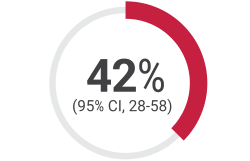
of patients with the T315I mutation received MMR by 24 weeks (n=45)
MMR was achieved by 96 weeks in 49% (95% CI, 34-64) of the patients (n=45) treated with SCEMBLIX.1
The median duration of treatment was 108 weeks (range: 2 to 215 weeks).1
By Week 24, MMR was achieved in 58% (n=11/19) in ponatinib-naive patients vs 31% (n=8/26) of patients pretreated with ponatinib13
Percentages of patients who had previously received 1, 2, 3, 4, or 5 or more TKIs were 18%, 31%, 36%, 13%, and 2.2%, respectively1
Efficacy was based on 45 patients with Ph+ CML-CP who have the T315I mutation who received SCEMBLIX at a dose of 200 mg bid. Patients continued treatment until unacceptable toxicity or treatment failure occurred.1
bid, twice daily; CCyR, complete cytogenetic response; CML-CP, chronic myeloid leukemia in chronic phase; IS, International Scale; MCyR, major cytogenetic response; MMR, major molecular response; MR, molecular response; qd, once daily; TKI, tyrosine kinase inhibitor.
MMR was defined as BCR::ABL1IS ≤0.1%.1
CCyR was defined as 0% of Philadelphia chromosome–positive metaphases in bone marrow aspirate with at least 20 examined.1
MCyR was defined as 0% to 35% Ph+ metaphases.3
MR4 was defined as BCR::ABL1IS ≤0.01%.2
MR4.5 was defined as BCR::ABL1IS ≤0.0032%.2
aMust meet the definition of treatment failure per the 2013 European LeukemiaNet recommendations. Patients meeting treatment failure criteria on bosutinib could be switched to SCEMBLIX.2
bDefined as nonhematologic grade 3 or 4 toxicity while on therapy; persistent grade 2 toxicity, unresponsive to optimal management, including dose adjustments; or hematologic grade 3 or 4 toxicity while on therapy, recurrent after dose reduction to the lowest recommended dose.2
cPatients will continue to receive study treatment for up to 96 weeks after the last patient’s first dose or 48 weeks after the last patient switches to SCEMBLIX, whichever is longer.2
dEstimated using a common risk difference stratified by baseline MCyR status.1
eEstimated using a Cochran-Mantel-Haenszel 2-sided test stratified by baseline MCyR status.1
fCCyR analysis based on patients who were not in CCyR at baseline.1